# Dragon's Lair: Sharp X68000 port
Porting Dragon's Lair to a stock X68000 (68000 @ 10MHz, 2MB, SCSI).
This is fundamentally a **video codec problem**, not a game-logic problem. The
game logic is a scene table with branching input windows; the difficulty is
pushing ~22 minutes of Don Bluth animation through a 10MHz 68000.
## What it looks like
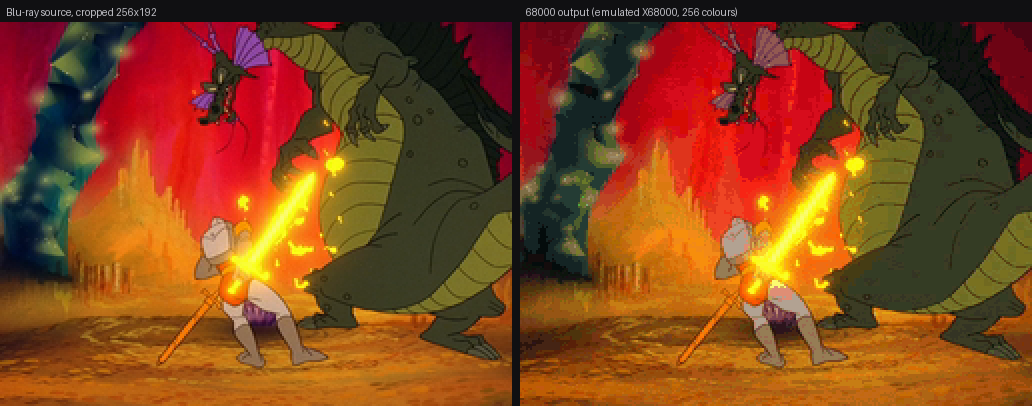
Left, the Blu-ray frame cropped to 256x192. Right, the same frame **as the
emulated 68000 actually drew it**: 256 colours out of the X68000's 65536, one
16-colour-per-4x4-block codebook, decoded by `src/player/decode.s` from the
container. Not a re-render. These are the pixels MAME had on screen, pulled out
of its own snapshot, 2x nearest-neighbour, no filtering.
**The player, running.** 119 frames out of a **256 KB ring buffer on an emulated
stock 2 MB X68000**, paced to a 12 fps frame clock, streamed from a host file at
488 KB/s by `src/player/stream.s` with no Lua in the decode path. Source on the
left, the machine's screen on the right. (This recording was paced by the host;
the 68000 now keeps that clock itself, off the CRTC's V-DISP, and the same 120
frames decode pixel-exact under it — `src/player/clock.i`, FINDINGS 54.)
[`docs/img/player.webm`](docs/img/player.webm) (119 frames, 12 fps, VP9)
116 of those 119 frames are **pixel-exact** against `tools/encoder/dlx.py`'s
reference reconstruction. The other three are **torn**: the top of the picture
is frame *n* and the bottom still holds frame *n-1*, because MAME captured the
screen while the block loop was partway down it. That is not a rig artefact.
`decode.s` writes straight to the displayed page, so a real player tears the
same way. `tools/media/make_readme_media.py` asserts the tear rather than
trimming it: every differing pixel has to come from the previous frame, or it
refuses to build.
**What the decoder is doing.** The same window with the block-mode map beside
it. **Black is SKIP** (costs nothing, draws nothing, the previous frame stands),
**blue is V1** (one codebook index for a whole 4x4 block), **amber is V4** (four
indices), **red is RAW** (sixteen bytes verbatim). The mode mix is what every
cost table in `docs/FINDINGS.md` is really about: V4 costs 1.5x V1, and the mode
decision is charged both bytes *and* cycles, which is why a byte-rich profile
buys its way out to RAW rather than V4.
[`docs/img/modes.webm`](docs/img/modes.webm) (the same 119 frames, with the mode map)
**Name the layer.** Everything above is **emulated**: MAME 0.277 `x68000`,
`-bios ipl10`, stock 10 MHz / 2 MB, cross-checked frame for frame on a second
CPU core (px68k's C68K). Nothing in this project has run on real hardware yet.
## Where it stands
**The binding resource is the 68000's local BUS, not its clock.** The decoder
occupies 86.7% of it once instruction prefetch is counted, and 52 of the 53
frames that miss the 12fps budget miss on the bus (FINDINGS 38). Read that
before optimising anything for cycles.
**The decoder works and is measured.** `decode.s` draws blocks and v7 literal
spans pixel-exact under both CPU cores, and costs inside the player what the
standalone blit benchmark said it would, to 0.2% (FINDINGS 41).
**The delivery path works too.** `stream.s` decodes the whole 120-frame window
out of a 256 KB ring on a stock 2 MB machine, final frame pixel-exact, with the
container in a host file rather than preloaded into RAM. The constraint is
**contiguity, not byte count**: the block loop reads with a monotonically
increasing `a0` and no bounds check, so the ring needs the whole next record
resident *and contiguous*, a condition no byte-counting buffer simulation can
see (FINDINGS 49).
**Seek slack is accumulated, not owned.** A ring's lookahead is built out of
`pipe - wire` and a seek spends all of it. At 488 KB/s a 256 KB ring needs 4.83
seconds of play to reach its 7-frame ceiling from empty, and 512 KB needs 8.42
seconds to reach 14, so a bigger ring raises the ceiling *and* lengthens the
climb. A branch point therefore asks "has there been enough play since the last
one", not "is the buffer big enough" (FINDINGS 51).
**There is no working delivery rate figure, deliberately.** `--bus`, `--kbps`
and `DLX_STREAM_KBPS` are required arguments with no defaults, so no table can
be scored against a rate its own output does not state. What replaces a constant
is a requirement: `tools/analysis/19_ring_stream.py` reports the **zero-prefill
pipe**, the rate a medium must clear for a container to need no prefill, which
is **513.2 KB/s** for the current candidate. That is a hardware acceptance test
to measure a BlueSCSI against (FINDINGS 50).
**The largest open number is W, the clocks stolen per delivered byte.** The
MB89352 is an 8-bit SPC, so the DMAC pays per byte rather than per word, which
is a 2x correction the project has already paid for once (FINDINGS 43). What W
costs is set by how the player programs the DMAC: 5 clocks a byte single
address with the bus held, 9 dual address held, 12 single address arbitrating
per byte, 16..19 dual address arbitrating per byte. The design's fate changes
completely across that ladder, and it is ours to choose.
**The one worked example on the machine is expensive.** The X68000 IPL ROM
programs all four HD63450 channels itself, and
`tools/analysis/21_iplrom_dmac.py` decodes that configuration out of the ROM
image and gates on the bytes still being there. Both the audio channel and the
on-board disk channel are dual address, 8-bit port, cycle steal *without* hold,
one external request per byte: **16..19 clocks a byte**, the top of the ladder.
For audio that is a settled figure and a small one, 1.25%..1.48% of a frame. For
the disk it is where nothing fits at any container size. The ROM drives SASI
rather than the MB89352, so it does not settle W, but a cheap configuration is
now the thing that has to be shown rather than assumed (FINDINGS 52).
**The player builds its own codebooks and palette now.** The two load-time
transforms — codebooks to word-per-pixel form, palette to `GGGGGRRRRRBBBBBI`
with the shared LSB picked per entry — ran host-side until session 21 and now
run on the 68000, out of the raw container header, byte-exact against the host
implementation on both CPU cores and with the palette read back out of the
hardware registers. A scene change costs **18.96 ms**, a third of one 12fps
frame slot. The finding underneath it is a cost nothing had counted: a scene
header is **5,920 bytes** that must arrive before frame 0, and in the currency
of seek slack those bytes lengthen the refill climb by 138 ms at 488 KB/s and by
**1.099 s at 451.4 KB/s**, because the surplus they are divided by goes to zero
(FINDINGS 53).
**The 68000 fills its own ring now, and the player's request loop costs more
than the medium does.** `src/player/ring.i` places records, prefills, keeps the
slack rule and seeks, out of a per-record index the container carries (DLX4).
The channel only moves bytes while it has a request and only the CPU can issue
one, so the disc **stands still between records** by an amount the player sets:
at 488 KB/s a one-deep request queue gives away **6.8% of the pipe and underruns
59 of 120 frames**, a two-deep one gives away 3.4% and underruns none — on a
container whose whole surplus over the wire is 8.7% (FINDINGS 55).
**The player runs off a real disc now, and PIO costs 87 clocks a byte.**
`src/player/xfer.i` answers the ring's request mailbox with a real READ(10) to a
real MB89352 instead of a host moving bytes at a modelled rate: 120 records,
4,488,588 B, **pixel-exact out of a 256 KB ring**, with a real mid-stream seek in
a second pass, and the **same 18 wraps** three different transports have now
produced. What it costs is the finding. Subtracting the same 120 frames run
twice gives **87.28 clocks per delivered byte**, and the 68000's own cycle table
for that loop says **87.15** — 0.2% apart, so the cost is the instruction stream
rather than the emulator's device model, and it is the first number this rig has
produced that a real board would also pay. At this container's mean record that
is **391.8% of a 12 fps frame**; the machine's own V-DISP clock agrees from the
other end at **2.57 fps**. Against the W ladder — 22.4% of a frame at 5 clocks a
byte, 85.3% at 19 — **the CPU doing the work itself is 4.6x the worst DMA
configuration this project has found and 17.5x the best.** Getting the DMAC to
hold the bus is no longer worth 9 against 19; it is worth 87 against either, and
it is the only thing left before a player (FINDINGS 58).
**The DMAC drives the data phase now, and it holds the bus.** `src/player/dma.i`
programs an HD63450 channel and hands it the SCSI data phase: **the same 2,048
bytes come off the disc three ways — PIO, the channel with the bus held, the
channel stealing cycles — and all three are byte-exact.** The evidence that the
DMAC and not the CPU is driving it never looks at the data register, which
cannot answer the question: with the DMAC's OWN asserted, MAME cannot tell a
CPU-driven byte at `$EA0015` from a DMAC-driven one. What it looks at instead is
**the CPU's own progress**. MTC is sampled by the instruction *after* the one
that starts the channel; held, it reads **zero of 2,048** — the whole transfer
happened between two instructions, because the 68000 did not execute in between
— while the stealing configuration reads the full count and the CPU then goes
round its own loop 426 times. Put the stealing registers in the held slot and
the run still delivers every byte and the gate goes **red**, which is what says
the counter can come out different (FINDINGS 59.1).
**And auto-request is charged by time, not by byte.** The card as MAME models it
has **no request line to the DMAC at all** — its flow control is DTACK — so
every configuration that can be run against it is auto-request, and an
auto-requested channel does not know whether the device is ready: it spends its
share of the bus either way. Every `W` in this project is clocks per *delivered*
byte, which presumes the device asks; here the cost scales with **how long the
record takes to arrive**, so halving the delivery rate *doubles* the CPU cost of
the same record. Priced from the MC68450's own limited-rate constants against an
explicit 460 KB/s: max rate costs the whole **95.3% of a frame** the record takes
to land, and of the four bus shares the GCR can be programmed for — 50, 25,
12.5, 6.25% — **only 50% carries the rate**, at 10.61 clocks a byte and 47.6% of
a frame. The GCR is a design lever nothing in this tree had named (FINDINGS
59.3).
**A record is not a sector, and the cheapest fix is a re-encode.** 117 of 120
records start part way into a 512 B block, and reading whole blocks into the
ring corrupts the neighbouring records rather than merely wasting bytes — the
block loop reads with no bounds check. PIO absorbs this for free by simply not
storing the bytes outside the window, which is a property that disappears the
moment a DMA channel takes over. Priced three ways: windowed PIO is +1.34% on
the wire and cannot be done by a channel at all; a bounce buffer is +1.34% and
**+5 clocks on every delivered byte**, 22.4% of a frame; sector-aligning records
in the container is **+0.43% and zero clocks**. The last wins on both axes and
joins the re-encode bundle (FINDINGS 58.3). **Session 27 made it a
precondition rather than a preference**: the transport now *refuses* a windowed
read when the data phase is the channel's, so the container has to meet it
before the DMAC can sit behind the ring (FINDINGS 59.4).
**The scene graph is in, and the worst gap between two decision points is
zero.** `tools/import/scenegraph.py` imports the arcade scene graph — 40 scenes,
516 sequences, 906 input windows — and 5.4% of the game's 612 branch transitions
open an input window on the first frame of a clip the disc *seeked to*, so two
seeks can fall back to back with no play between them. A rule of the form "has
there been enough play since the last branch" can therefore be answered no by
the **content**, not by the buffer. It does not break the design: a branch on an
empty ring costs the 2-record prefill, **149.7 ms at 488 KB/s**, not the climb.
What it removes is margin — at that rate in a 256 KB ring, **76% of this game's
branch points arrive before the ring has refilled**, and a 512 KB ring makes it
90%, because doubling the ceiling does not touch `pipe - wire` (FINDINGS 56).
**Nothing outside-derived is committed here.** The scene graph is not
redistributable from this tree; it is regenerated from a reader's own clones
into gitignored `tmp/`, and `tools/import/scenegraph.py` is the single file in
the repo coupled to those projects — everything downstream reads `DLXSCENE1`,
this project's own schema, with the sources' attribution carried in it.
DirkSimple is zlib (Ryan C. Gordon); the SNES chapter set is MIT (Chad
Doebelin) and, by its own README, *derived* from DirkSimple rather than an
independent transcription, which struck a cross-check this project had planned
on for eight sessions.
**Current encode:** 496.7 KB/s at 29.19 dB, 1 frame of 120 over the 12fps
budget, and that one is frame 0, the intra frame, late on purpose.
**Green-light check:** `./tools/bench/check.sh` (~4 min, needs the Blu-ray
mounted) re-runs both display regression tests, the rate-control drift gate, the
display-path coherency counterexample, a 120-frame 68000 decode on two CPU
cores, the ring and paced-ring passes, the DMAC configuration gate and the
load-time transforms on both cores, then imports and gates the scene graph
when a DirkSimple checkout is present, then prints `ALL GREEN`.
## Reproducing this
**No media ships in this repo and none of it is redistributable.** Bring your
own Dragon's Lair Blu-ray. Everything else needed to rebuild every number and
every picture above is either here or is packaged.
You need:
| | |
|---|---|
| the disc | loop-mounted read-only: `udisksctl loop-setup -r -f DRAGONS_LAIR.iso`. The tree was built against a decrypted UDF 2.x image. 7-Zip cannot read UDF 2.x, so use the loop mount |
| `python3` | plus **numpy** and **Pillow**, and nothing else. The k-means is hand-rolled rather than pulling in sklearn |
| `ffmpeg` / `ffprobe` | frame extraction, and the clips above |
| **MAME** | tested on 0.277, with the `x68000` ROM set. The rigs drive it headless via `-autoboot_script` |
| vasm (m68k, Motorola syntax) | **vendored**: `tools/vasm/vasmm68k_mot` is a Linux x86-64 binary, with the source tarball beside it to rebuild elsewhere |
Then:
```sh
export DLX_BDROM=/path/to/your/mounted/bluray # if not /media/$USER/BDROM
./tools/bench/check.sh # ~3 min, prints ALL GREEN
```
`DLX_BDROM` is honoured by every tool that reads the disc. Two stages are
optional and **skip rather than fail** when their input is absent, because both
live outside this repo:
- `PX68K=/path/to/px68k` for the second-CPU-core gate. This is the cheapest
strong test in the tree (seconds, no MAME, no ROMs) and it is what licenses
the bus and cycle figures.
- `IPLROM=/path/to/iplrom.dat` for the DMAC configuration gate. Defaults to
`~/mame/roms/iplrom.dat`.
To rebuild the stills and clips in `docs/img/` you also need a paced recording
run; see the header of `tools/media/make_readme_media.py`.
**Scene selection is a hard-coded stream number, not a search.** The gates use
streams `00020` and `00223` of the disc's 224 `.m2ts` files. A different
pressing may number them differently, and if so the green light will extract the
wrong footage rather than fail, so check that `tmp/fr_singe/` looks like the
Singe encounter before trusting any figure.
**Not every large stream is game footage.** `00216` is the feature with a
burned-in commentary picture-in-picture and `00215` is the commentary itself,
the two largest files on the disc. The clean 9.4-minute animation is **`00223`**
(FINDINGS 25.1).
## Encoder
```
python3 tools/encoder/extract.py 00020 /tmp/fr 12 crop
python3 tools/encoder/encode.py /tmp/fr out.dlx --profile scsi --preview p.png
```
The codec is a Cinepak-style hybrid: each 4x4 block is coded as SKIP, one 4x4
codeword, four 2x2 codewords, or RAW literal pixels, chosen per block by
rate-distortion. The RAW escape means `lam=0` is pixel-exact against the
palettised frame, so the quality knob spans lossless to heavily compressed
without changing the bitstream.
**Two byte budgets, not one.** `--kbps` is the quality rate point and
`--span-kbps` is the ceiling the span pass may draw on. They are different
things: the profile is chosen, the pipe is hardware, and bytes between them buy
a better picture if spent on `lam`, the 68000's deadline if spent on spans, and
nothing if left unspent. Spans run before `mu` because a span pays in bytes and
`mu` pays in picture (FINDINGS 41.2).
**Two ceilings, on two different axes.** The second is the 68000's decode
budget: `mu` is bisected per frame against 833,333 cycles so the frame also
*decodes* in time, which takes the worst sustained window from 37 frames over
budget to 1, for 0.62 dB at `scsi` (FINDINGS 31). It is on by default and
`--no-cpu-fit` turns it off. Unlike bytes, cycles have no bucket: there is no
double buffer to decode ahead into, so it is a hard per-frame ceiling.
**One profile, `scsi`, at 280 KB/s.** The 110 KB/s `sasi` profile was dropped on
capacity rather than bandwidth, since a SASI volume is limited to 40 MB and the
game's 22.8 minutes is 146 MiB even at that rate (FINDINGS 32). The rate point
may return under another name once the delivery medium is settled, because a 1x
CD-ROM sustains ~150 KB/s and CD-ROM is the only period medium with the
capacity.
The profile bitrate is a **ceiling**: `lam` is bisected per frame under a leaky
bucket, so the profile's `lam` is a quality floor rather than a setting
(`--fixed-lam` opts out). At `--spans all` none of that binds, though. A
32-frame bucket emits the same container byte for byte as an 8-frame one and
`lam` never leaves its floor on any frame of the reference window, because the
rate is set by the span pass and by `mu` (FINDINGS 44.3). Two known unit
inconsistencies on that side are implemented and default off because they
measure as a wash: `--joint-decide` prices a byte at `lam + mu*c` rather than
`lam`, and `--joint-bucket` stops the bucket lending clocks it cannot repay.
An encode is ~95% k-means. A 120-frame window is ~29 s, of which ~22 s is
training the two codebooks.
Profiles are derived from a bandwidth figure rather than chosen by eye:
```
python3 tools/encoder/profile_gen.py --bw-mbps 4 --name scsi
```
## Documentation
- **`docs/STATUS.md`** is the current state, working setup, blockers and next
steps. **Start here.** It also lists what has been explicitly abandoned, so
old ideas do not get re-proposed.
- **`docs/ROADMAP.md`** is the remaining work to a completion target, and which
milestone that target is. Read it with STATUS rather than instead of it:
STATUS holds the measurements, ROADMAP holds the shape and goes stale first.
- **`docs/FINDINGS.md`** is measured hardware facts, content statistics, the
codec decision, and a section on measurement traps that produced three
separate false results. Read §4 before trusting any pipeline number. It is
append-only and later sections overturn earlier ones; superseded sections
carry a blockquote pointing at the correction.
- **`docs/BENCHMARK.md`** is how to measure the storage subsystem, and why a
bandwidth figure out of MAME would be meaningless.
- **`docs/HARDWARE.md`** is the X68000 GVRAM/CRTC reference.
## Layout
```
docs/ findings, status, roadmap, hardware reference
docs/img/ the stills and clips above, built from a real emulated run
tools/analysis/ measurement scripts, numbered in the order they were written.
Run from the repo root; they import from tools/encoder/.
01 and 02 are marked BROKEN deliberately and kept as
regression references.
10 is a COUNTEREXAMPLE and exits non-zero by design: it
demonstrates that the two-display-path plan corrupts 70 of 120
frames, which is why decode.s has one display path.
15 measures how much of the 68000's local bus the decoder
occupies and exits non-zero if its derived model stops
matching the harness's measurement.
16 is the DLX3 span container round-trip gate: it encodes,
writes the container, reads it back with the reference decoder
and fails if a pixel differs, or if it emitted too few spans to
have tested anything.
19 models the ring's ADDRESSES rather than its occupancy,
because each record must be contiguous and not merely resident,
and reports the zero-prefill pipe.
20 is an independent Python re-derivation of the seek-slack
model, sharing no code with the Lua producer it checks.
21 decodes the IPL ROM's HD63450 configuration and gates on the
bytes being where it says they are.
22 prices a scene change: header bytes, load-time clocks and
what both cost in accumulated seek slack, across explicit
rates. Its cycle counts are PARSED out of the rig's log, not
pasted in, so they cannot go stale silently.
buscost.py is the shared bus-cycle table. The per-block
constants live in tools/encoder/vq_hybrid.py and are imported,
never copied.
tools/bench/ MAME Lua injection harness and 68000 benchmark sources.
check.sh is the green light.
blit.s/blit.lua time the full-frame GVRAM blit on the 68000
itself. Not part of check.sh, because wall timings would make
the green light host-sensitive.
span.sh measures the literal-span mode the same way and
asserts that every one of its 36 timing configs drew a
pixel-exact frame, the count taken from generated metadata so
a new config cannot weaken the gate.
crtc_mode.lua is the single source of truth for CRTC R00-R08
and R20. Do not write CRTC values anywhere else.
prep_dlx.py/decode.lua/verify_decode.py load, time and verify
decode.s. prep_stream.py/stream.lua do the same for stream.s,
but lay the container out as a DISK in a host file and feed it
through a bounded ring at a modelled pipe rate, so the rig is
not bounded by the emulated machine's RAM and a stock 2 MB
machine runs the whole window. dlxload.py holds the
codebook/palette load-time maths both preps share -- and
the reference src/player/load.i is gated against.
prep_load.py/load.lua/verify_load.py/load_run.sh run those
transforms ON the 68000 and compare all 10,752 output bytes
with dlxload.py's, palette words read back out of the palette
registers rather than a RAM shadow.
tools/bench/c68k/ headless px68k C68K harness, a SECOND emulator for every
68000 cycle figure. Links only px68k's CPU core: no SDL, no
ROMs, no emulated machine. `make PX68K=~/src/px68k` then
run.sh; verify_c68k.py checks the decode is pixel-exact, which
is what licenses the cycle numbers. It also counts BUS cycles,
which MAME cannot report. The Makefile's -no-pie and the
harness's MAP_32BIT arena are load-bearing: C68K truncates
host pointers to 32 bits.
25 imports nothing itself: it reads the DLXSCENE1 scene
table and reports the worst gap between two decision points,
what the input layer has to survive, and what both cost in
51.3's accumulated slack across explicit rates.
tools/import/ the ONLY code in this tree coupled to somebody else's source.
scenegraph.py reads a DirkSimple checkout (and optionally the
SNES chapter XMLs) and writes tmp/scenegraph.json in this
project's own DLXSCENE1 schema, with the sources' licences and
attribution inside it. Nothing is vendored and the output is
gitignored derived data.
tools/media/ builds docs/img/ from a paced recording run
tools/vasm/ vasm m68k assembler, binary plus source tarball
tools/encoder/ hybrid VQ encoder and DLX3 container writer.
spans.py is the v7 span geometry, selection and serialiser,
and the single place the chain layout is stated on the encoder
side. It must match blit.s and decode.s: 11 coarse units of
24 px, 11 fine of 2.
DLX2 4-byte-aligns every frame record, because an odd move.l
is an ADDRESS ERROR on a 68000, not a slow read.
dlx.py is the reference DECODER, ground truth for the 68000.
24 models the ring with the 68000 owning it: the request
queue, the poll-only-when-not-decoding rule and 54.4's frame
cadence, and reports the pipe the player's own loop gives away.
src/player/ decode.s is the 68000 DLX3 decoder with a preloaded-stream
front-end. stream.s is the same decoder behind a bounded ring.
load.i is the LOAD-time half: codebook expansion and palette
packing, out of the raw container header, with loadgate.s as
its rig front-end. Its three scratch tables describe the
machine rather than the scene, so they are a separate entry
point a player calls once at boot.
ring.i is the RING PRODUCER: `aligned` placement, the
descriptor ring, the prefill policy, 51.2's slack rule as
arithmetic (ring_may_seek) and a seek. It reads the DLX4 record
index because a player cannot learn a record's length by
walking a stream it has not fetched.
Both include frame.i (the block loop and span chain) and
geom.i (the constants), so there is exactly ONE copy of the
bytes every cycle constant is fitted to. The span pass is
blit.s v7 verbatim, the same instruction sequence the
66.0/9.143/9.978 clock fit was measured on, so do not tidy it.
check.sh asserts decode.s still assembles to the same 1,296
bytes.
assets/ extracted frames and audio (gitignored)
```
Source media (`DRAGONS_LAIR.iso`) and ROMs are gitignored. Supply your own.